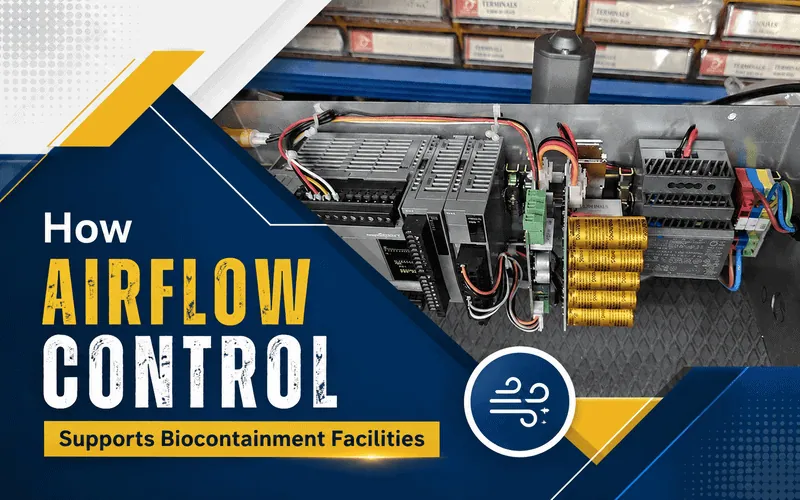
Biocontainment facilities require a carefully balanced ventilation system to keep airflow moving in the intended direction and maintain appropriate pressure relationships between spaces.
A venturi air valve can play an important role in this type of HVAC design by providing consistent, pressure-independent airflow control. This is particularly useful in laboratories where ventilation requirements can change throughout the day.
When supply and exhaust airflow are properly coordinated, the HVAC system can respond to changing demands while helping maintain the environmental conditions established for the facility.
Why Airflow Management Is Important
Airflow in a biocontainment laboratory is not simply about providing fresh air or removing stale air. The way air moves between rooms is an important part of the facility’s overall design.
Many controlled laboratory environments rely on pressure differences between adjacent spaces. These differences help establish a preferred direction of airflow, with air generally moving toward areas requiring greater containment rather than away from them.
Maintaining that relationship requires more than setting a fixed airflow rate. Laboratory conditions can change as equipment operates, exhaust requirements vary, or room access changes. The ventilation system therefore needs to accommodate these fluctuations without losing control of the intended airflow balance.
Pressure-Independent Control for Laboratory HVAC
One of the challenges in laboratory ventilation is that duct pressure is rarely constant. Changes elsewhere in the HVAC system can cause static pressure to rise or fall, which can affect airflow through conventional control devices.
Pressure-independent airflow control addresses this issue by allowing the control device to maintain a defined airflow set point despite variations in system pressure within its operating range.
This can simplify airflow management in laboratories where multiple zones and exhaust systems operate simultaneously. Instead of relying on a fixed damper position, the control system can adjust airflow as conditions change.
For designers, this can provide greater predictability when coordinating supply and exhaust requirements across different areas of a facility.
Keeping Supply and Exhaust in Balance
Supply and exhaust airflow are closely connected in a controlled laboratory. A significant change in one can influence the operating conditions of the entire room.
Consider a laboratory with a fume hood. When the hood requires more exhaust airflow, additional supply airflow may be needed to maintain the room’s overall air balance. If the supply side does not respond appropriately, the resulting imbalance can affect room pressure.
A coordinated airflow strategy allows supply and exhaust components to work together. The objective is not necessarily to keep every airflow value constant, but to maintain the required relationship between them as operating conditions change.
This approach can be particularly valuable in laboratories with multiple exhaust devices or areas where ventilation demand varies during normal operation.
Responding to Changing Laboratory Conditions
Laboratories are dynamic environments. A ventilation system may need to accommodate changes in equipment operation, fume hood usage, or other exhaust requirements throughout the day.
Slow or inconsistent airflow response can make it more difficult to maintain stable conditions when these changes occur. Responsive control gives the HVAC system a better ability to adjust to new airflow requirements.
Fast-response airflow control can be especially useful where exhaust demand changes quickly. Rather than waiting for conditions to stabilize before adjusting, the control system can respond to changes in the required airflow set point.
The result is a ventilation system that is better suited to the variable operating conditions found in modern research and laboratory environments.
Integrating Airflow Control With Building Automation
Airflow control is increasingly connected to the broader building automation system. This allows ventilation equipment to exchange information with central controls and become part of a coordinated HVAC strategy.
Depending on the system configuration, airflow controllers can receive set points, provide operating information, and communicate with building management platforms through protocols such as BACnet or MODBUS.
For facility operators, this type of integration can make it easier to monitor ventilation performance and coordinate different components of the HVAC system.
It also allows airflow requirements to be managed as part of programmed operating sequences rather than relying entirely on manual adjustments.
Fume Hoods and Laboratory Exhaust
Fume hoods are a good example of why precise airflow control matters in laboratory environments. Their exhaust requirements can vary depending on how the laboratory is being used.
When hood airflow changes, the HVAC system needs to account for the resulting change in exhaust volume. Supply air and other exhaust systems may need to adjust accordingly to maintain the desired room conditions.
Using airflow control devices on supply, return, and exhaust systems can help coordinate these changes. In a properly designed system, the different airflow components work together rather than operating as independent pieces of equipment.
This coordinated approach can help maintain a more stable ventilation environment while allowing individual laboratory systems to operate according to their requirements.
The Importance of Proper Calibration
Even a well-designed airflow control system depends on accurate setup. The selected airflow range, control set points, and installation conditions all affect how the system performs in practice.
Calibration is therefore an important part of commissioning laboratory ventilation equipment. Airflow should be verified against the required design values, and the control sequence should be checked under different operating conditions.
Factory calibration can provide a useful starting point, but final system commissioning remains important because the installed equipment operates within a larger ductwork and HVAC system.
Regular verification can also help identify changes in performance that may occur as equipment, filters, or other parts of the ventilation system age.
Designing the System as a Whole
Airflow control should always be considered as one part of the overall biocontainment HVAC strategy. The valve, sensors, controllers, ductwork, exhaust equipment, filtration, and room design all influence the final operating conditions.
Choosing an airflow control device should therefore begin with the requirements of the facility rather than the equipment alone. Engineers need to consider the required airflow range, pressure conditions, response requirements, control architecture, and how different ventilation components will interact.
When these elements are designed together, the HVAC system can provide more consistent and predictable airflow performance.
Conclusion
Reliable airflow management is an essential consideration in biocontainment and other controlled laboratory environments. Maintaining appropriate relationships between supply and exhaust airflow can help support the pressure conditions and directional airflow established by the facility’s HVAC design.
Pressure-independent control, responsive operation, coordinated exhaust management, and building automation integration can all contribute to a more adaptable laboratory ventilation system. The most effective results come from treating airflow control as part of a complete HVAC strategy rather than as an isolated component.
For laboratories and critical environments evaluating these types of airflow-control solutions, EB Air Control is one example of a manufacturer working with Venturi-based airflow control technology for specialized HVAC applications.